
I first started thinking about parallelism while looking at Outlook, and then looking again at how my team used their own calendars. Most people do not work with AI in parallel. Most users either do not use it at all, or they treat it as a separate activity: something to plan for, something to schedule, something to do later when there is time to sit down and prompt properly.
That is better than nothing, but it is not the real opportunity. The real opportunity is not just using AI to help with work. It is using it alongside work, in the same day, in the same flow, in the same hour as everything else that already needs to happen.
Why it matters
If you are not using AI at all, the cost is starting to become obvious.
You end up spending large parts of the week doing things that are fully machine-ready. Repetitive admin. Data handling. First-pass research. The sort of work that does not need your full attention but still takes your time.
That often leads to the familiar pattern: tasks spilling into lunch, work stretching into the evening, and recurring jobs becoming a low-level drag on the rest of the week. Or worse, tasks or projects you want to start, but never get off the ground.
Personal development is frequently thrown onto the do-it-later pile.
If you are using AI, but not in parallel, you are improving things, but the structure is different. You make space to learn the tool. You block time to prompt. You sit down with a task, then ask the model to help you finish it. Essential early on, but it still means the human and the machine are often waiting on each other.
Parallelism is different.
Parallelism is when your human work and your machine-ready work run side by side. You are in a team meeting while Codex is preparing analysis for a call tomorrow. You are handling the uniquely human parts of the day, while AI is quietly moving the next batch of work forward.
Two diaries, overlapping each other. One for the human schedule. One for the machine-led schedule.
That is the force multiplier.
The second calendar
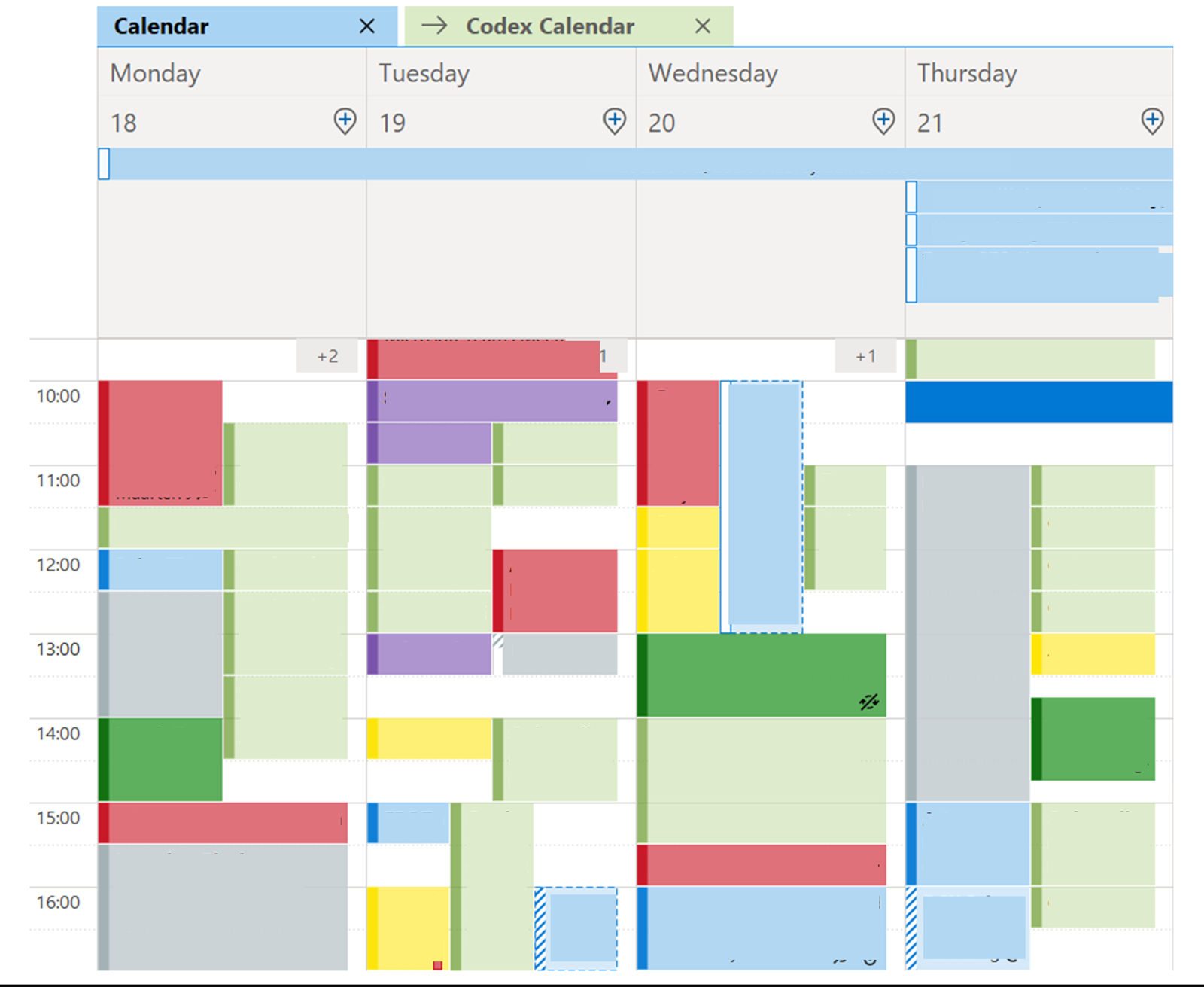
In the screenshot, the light green items represent the Codex calendar. The other colours are my own diary, prioritised by type and urgency.
That second layer changes the shape of the working day. Instead of one long queue of tasks, you have two layers of work moving at once.
The human layer still contains meetings, decisions, conversations, context, and the things that only a person can do. The Codex layer can contain machine-ready work, preparatory work, background work, analytical work, and the jobs that are better done while your attention is elsewhere.
It reduces the number of tasks that survive only because you are waiting for a spare hour.
It helps prevent the day being eaten by work that does not need to take prime human attention.
Parallelism is not about squeezing more and more work into the same day until you are overloaded.
It is about using the right kind of attention for the right kind of work.
The best work with AI happens when we stop treating it as a separate event. It is not a place you visit once everything else is done. It is a working layer that can move beside you.
What I am trying to build
This is one of the ideas I want Cult of Codex to explore more deeply.
The workflows, or as we like to call them, Rituals, created for this site are not just about automation in the abstract. They are practical ways to make work easier, faster, and more effective. In that sense, parallelism is a natural extension of the project.
Some Rituals will be simple and completely non-AI.
Some will use AI to help set up a process, then run without it.
And some will live in the more ambitious space where the human and the model are working side by side.
My best work with AI does not happen when I carve out a separate block of time and wait for the perfect prompt. Not anymore.
It happens when the model and I clock on together.
We do our best work with AI when we work in parallel. That is the philosophy behind parallelism.